This online exhibit is based on the exhibit of the same name that was on display at the Albert H. Nahmad Panama Canal Gallery from March 26, 2022 to February 28, 2023. Unless otherwise noted, all items are from the Panama Canal Museum Collection, Special & Area Studies Collections, George A. Smathers Libraries, University of Florida.
Curated by Elizabeth Bemis | Designed by Katiana Bagué
Udo J. Keppler
Waiting, June 22,1904. Puck. 94500772. Library of Congress.
Udo J. Keppler, Waiting, June 22,1904. Puck. 94500772. Library of Congress.
Over 235 million tons of rock and dirt were excavated to create the Panama Canal. Yet, John Stevens, the Chief Engineer of the project, saw sanitation efforts and workers’ health as the greatest challenge when he remarked, “the digging is the least thing of all.” Shortly after arriving in Panama, Stevens turned over the money and workforce to Dr. William Gorgas, the Chief Sanitary Officer. The hope was that Gorgas could manage the environmental conditions that were making the project so deadly.
The tremendous public health infrastructure necessary before and during construction evolved into an equally monumental and vital system designed to protect the Canal’s functioning and keep the people operating it safe from injury and disease. Individuals living at the Canal had typical healthcare needs, but they also faced unique and significant challenges brought on by their location at the crossroads of global trade. Community care, medical studies, vaccines, and quarantine were a part of their everyday life and work. As an important center of healthcare and research, the community participated in innovations and discoveries that improved their own lives as well as global health.
Malaria
During construction, two of the most significant problems were malaria and yellow fever, infectious diseases that caused the deaths of thousands of workers.
Malaria was a far more significant obstacle than the other endemic diseases in Panama due to the level of chronic infection and the extended length of time that a person is contagious. Unlike yellow fever, which offers permanent immunity after infection, malaria can be contracted multiple times. To combat the prevalence of malaria during construction, workers were given daily doses of quinine, a malaria treatment since the 1600s. Have you ever traveled abroad and had to take anti-malaria medication?
Malaria Death Rate Among Employees, 1906-1942, 1942.
2011.53.30.2.
Map of Areas Sanitated Against Malaria Mosquitos from Twenty-five Years of American Medical Activity on the Isthmus of Panama 1904-1929, 1928. Panama Canal Press. RA 192.A6 1929.
To manage the communal ecosystem that existed between the U.S.-controlled Canal Zone and the Republic of Panama, the two countries signed a legal agreement granting the U.S. control and responsibility over sanitation in Colón and Panama City. Significant U.S. sanitation efforts included paving roads, installing proper drainage, clearing and controlling flora, killing mosquitos, and draining or filling any standing water.
Yellow Fever
In 1886, Dr. Carlos J. Finlay, a Cuban physician, published his findings that the Aedes aegypti mosquito transmitted yellow fever. Based on Finlay’s evidence, Gorgas and other researchers made progress combatting yellow fever in Cuba. Gorgas was then able to use this experience as a blueprint for Panama. Controlling the spread of yellow fever was critical for the success of U.S. construction.
W.A. Rogers
The First Mountain to be Moved, 1905. Harper’s Weekly. 2005.86.927.
W.A. Rogers, The First Mountain to be Moved, 1905. Harper’s Weekly. 2005.86.927.
During an 1873 Louisiana epidemic, yellow fever was often referred to as “Yellow Jack.” The nickname came from the tradition of flying yellow flags in areas under quarantine, with “Jack” being the common slang term for flag. This Harper’s Weekly cover refers to yellow fever as, “The First Mountain to be Moved.” It acknowledges the necessity of controlling the disease’s impact in the area before construction could begin successfully. The two figures at the bottom of the image are Theodore Roosevelt and Uncle Sam.
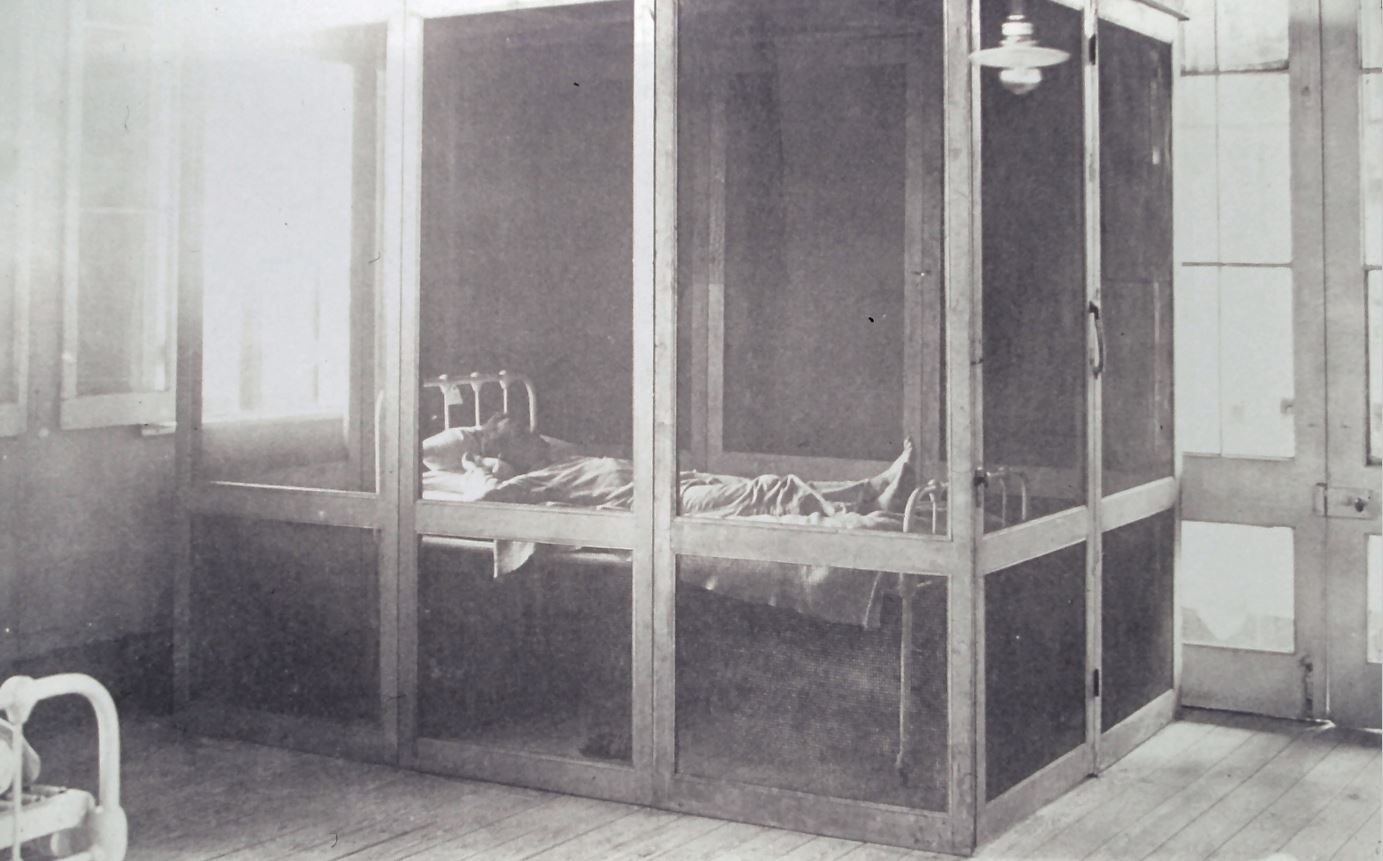
Patients with yellow fever were often placed in screened isolation rooms to avoid mosquitos and infecting additional people. In 1913, nurse Jessie Murdoch described how nurses had to swath themselves in bandages soaked in citronella oil because they were not protected by these same wire cages. In the 1920s and 1930s, a vaccine for yellow fever was created that helped stem the disease’s deadly effect. To date, 500 million doses have been given worldwide.
“During these days each employee provided himself with a small bottle containing kerosene and coconut oil, which was rubbed on the exposed parts of their bodies to keep away sandflies and mosquitos.”
Joseph Brewster, Barbados
Construction
Personal Injury Reports January 11, 1906 – October 1, 1907.
RG 185, Box 1. National Archives.
Image courtesy of Dr. Caroline Lieffers.
Personal Injury Reports January 11, 1906 – October 1, 1907. RG 185, Box 1. National Archives. Image courtesy of Dr. Caroline Lieffers.
After the challenges of sanitation were brought under control, the very difficult work of constructing the Canal commenced. Construction efforts were plagued by explosions, landslides, and other accidents that invariably resulted in mental distress, physical injury, loss of limbs, or death. The official death toll for the U.S. construction (1904-1914) is 5,609 although many historians believe that the actual number is much higher. If you include the French era of construction (1888-1889), the number of deaths is close to 30,000. This represents approximately 40% of the total workforce.
By 1912, the A.A. Marks Company had supplied over 200 artificial limbs for injuries related to U.S. Canal construction. They aggressively sought out business with the Isthmian Canal Commission (I.C.C.) and used incentives such as discounts, the creation of orders based on measurements instead of traditional plaster casts, and their proclaimed superior waterproof material. Sadly, those incentives did not always result in a positive outcome for the recipient of the limb, and many still suffered pain and limited mobility.
Ernest Hallen (American, 1875-1947)
Culebra Cut. Toe of Rock Slide, South End of Gold Hill, Showing Wreck of Steam Shovel #224, 1913. 2003.100.43.53.
Ernest Hallen (American, 1875-1947),Culebra Cut. Toe of Rock Slide, South End of Gold Hill, Showing Wreck of Steam Shovel #224, 1913. 2003.100.43.53.
Many workers’ injuries were severe enough that they were unable to continue with the physical labor of construction. Some of these workers were able to find other assignments, while others were repatriated to their home countries. A small group was sent to Corozal Farm, a facility designed for the long-term housing and low-wage employment of the disabled. The 600-acre farm included fruit trees, vegetables, animals, and a rose garden that supplied flowers to the commissaries. The farm also provided the Canal Zone hospital system with meat, eggs, and milk. The facility was intentionally separated from the main hospital to keep the residents out of sight. Their visible physical suffering did not coincide with the message of success that the U.S. was trying to promote through the Canal project. *Note the individual in the photo with a lost limb.
Dynamite
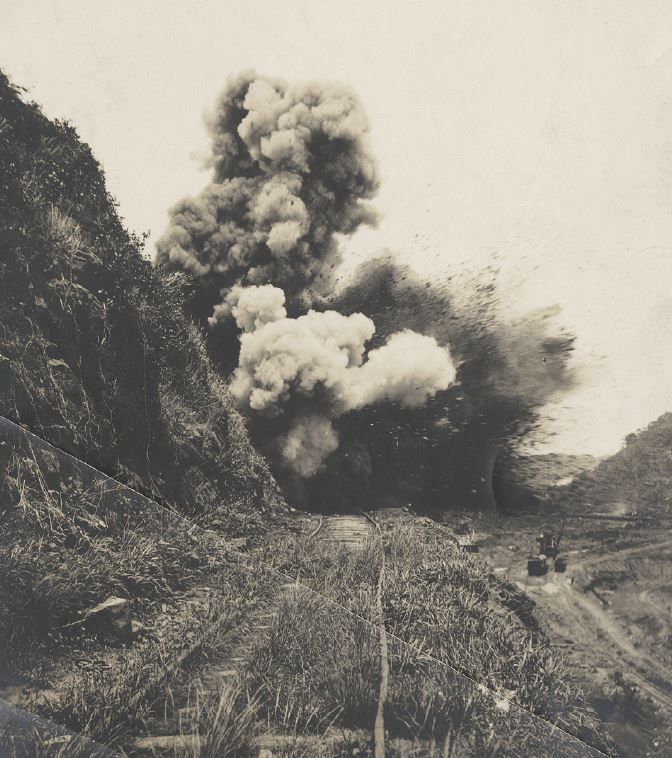
Over 60 million pounds of dynamite were used during the construction of the Canal. First, holes with a usual depth of 27 feet were drilled and filled with four to six sticks of dynamite. The sticks were then ignited to create a small chamber where up to 200 pounds of explosives were used to blast large areas of rock. This dynamite blast tube was excavated in the Culebra Cut decades after construction. It is unknown what part of the process caused the damage to this tube and if it was the result of one of the many accidents that occurred.
The deadliest accident during construction of the Canal happened on December 12, 1908. A premature, 25-ton dynamite explosion in an area near the Culebra Cut known as Bas Obispo killed 26 men and wounded 49 others.
“In 1908, 22 tons of dynamite was at Bas Obispo Cut and went off at 11:45a.m…It was something terrible and awful to look at. The explosion was heard and smoke could be seen 3 miles away from where I was living in Matachin. The shock of the blast knocked offed glasses from table and shelves in many homes, and some fell to the floor in their homes.”
Amos E. Clarke
Hospitals
Ambulance, Ancon Hospital, 1903-1919. 2003.3.23.14. Gift of Joe Wood.
Ambulance, Ancon Hospital, 1903-1919. 2003.3.23.14. Gift of Joe Wood.
The medical infrastructure established to support the Canal was extensive, and state-of-the-art facilities soon developed that served the employees of the Canal, the residents of the Canal Zone, the sailors and soldiers needing medical care as they passed through the waterway, and at times the residents of Panama.
Originally built during the French construction era and previously known as Ancon Hospital, Gorgas Hospital was the paramount medical facility in the Canal Zone.
C. Endara
Ancon Hospital, 1903-1918. 2013.8. Gift of Dusty Graham and Ann Lafferty.
C. Endara, Ancon Hospital, 1903-1918. 2013.8. Gift of Dusty Graham and Ann Lafferty.
From 1915 to 1919 new structures replaced the original wooden foundations, and in 1928 it was renamed. The hospital continued to grow, expanding with a new building to consolidate and elevate the level of care provided to the patients in 1965.
As provided for in the Panama Canal Treaties of 1977 (Torrijos-Carter Treaties), Gorgas Hospital was transferred to the Department of Defense on October 1, 1979, and continued to serve the U.S. military and civilian communities in Panama until it was turned over to the Republic of Panama in 1999.
I.C.C. Sanitarium, Taboga Island, Panama City, n.d.
2011.2.37. Gift of Joanne Ackley.
I.C.C. Sanitarium, Taboga Island, Panama City, n.d. 2011.2.37. Gift of Joanne Ackley.
How long do you need to rest to recover from extended illnesses? Before the wide use of antibiotics, long periods of rest lasting weeks or even months were prescribed as treatment. For this purpose, sanitariums were built as places to recover in the late 19th and 20th century. The French built a sanitarium on Taboga island that was later used by the U.S. during construction for the recovery of their workers. In 1915, the facility became the Hotel Aspinwall, which served as a bellwether for the island’s evolution into a popular leisure destination.
As part of the sanitation agreement between the U.S and the Republic of Panama, the U.S. was required to provide a mental health facility for people in Panama and the Canal Zone. Established in 1915, Corozal Hospital shared its grounds with the Corozal Farm, a facility that housed individuals disabled by chronic disease or injury. There was a large garden and a dairy where patients worked to provide food and milk for the hospital system of the Canal Zone. Eventually the dairy was closed and the garden was downsized to personal plots used for occupational therapy. Other recreational programs included cooking, sewing, and making straw items to sell.
Corozal Hospital From Twenty-five Years of American Medical Activity on the Isthmus of Panama 1904-1929, 1929. Panama Canal Press. RA 192.A6 1929.
2002.008.029. Gift of Martha J. Anderson.
Corozal Hospital From Twenty-five Years of American Medical Activity on the Isthmus of Panama 1904-1929, 1929. Panama Canal Press. RA 192.A6 1929. 2002.008.029. Gift of Martha J. Anderson.
Essential Workers
Letter of Employment to Anna L. Doolittle, June 21, 1907.
2004.94.2.3. Gift of Martha Gibson.
Nurse Mary Eugene Hibbard was the first woman to be hired to work in the Canal Zone. She came to the Isthmus in 1904 to serve as the Superintendent of Nurses at Ancon Hospital. Nursing jobs became important roles for women seeking the same type of opportunities as men, but who were barred from participation in the primary occupations of construction. Anna Doolittle followed in her footsteps in 1907 when she took a job working as a nurse in the Canal Zone.
At the age of 38, Adelaide Mackereth arrived in the Canal Zone in 1905 to serve as a nurse alongside many strong and adventurous women. She likely lived in a designated boarding house with other nurses, had a nighttime curfew of 10:30 pm, and entertained herself by playing card games, attending dances, and staging plays. How old were you when your curfew was 10:30 pm?
Adelaide P. Mackereth, n.d. 2004.46.4.1. Gift of
Martha Mackereth
Adelaide P. Mackereth, n.d. 2004.46.4.1. Gift of Martha Mackereth
Guna Who Worked in the Kitchen of the Hospital,
March 22, 1935. II.2021.36.47. Gift of Brad Wilde.
Guna Who Worked in the Kitchen of the Hospital, March 22, 1935. II.2021.36.47. Gift of Brad Wilde.
Men of the Guna, one of the indigenous communities in the Republic of Panama, came to work in the Canal Zone, many times in kitchens or on military bases. The back of the photo includes a description that describes the men. Guna is now the preferred term rather than San Blas Indians: “In front of administration building of Hospital, a few of the San Blast Indians who help do our kitchen work for us. They live here all time & doesn’t cost them any thing. The second from the right has traveled all over the states & also married an American girl but does not live together she can not stand the heat. His uncle is chief of all San Blast Indians, They have a little country of their own down in the interior.”
Palo Seco
Another requirement of the sanitation agreement between the U.S. and the Republic of Panama was that the U.S. maintain a facility to house and treat individuals with Hansen’s Disease, which was commonly known as Leprosy. These facilities, historically termed Leprosariums, Leper Asylums, or Leper Colonies, were created to segregate their residents from society. Palo Seco was a 500-acre complex about five miles away from Panama City that opened in 1907. Although a 1940s medical breakthrough allowed for Hansen’s disease to be treated through outpatient care, many residents chose to remain in the communities that had been their homes.
Palo Seco, n.d.
II.2022.5.1. Gift of Heywood Garlington.
Palo Seco, n.d. II.2022.5.1. Gift of Heywood Garlington.
Ernest Hallen (American, 1875-1947)
Patient Cultivating His Garden, July, 1916.
2008.18.1.26. Gift of Emily Murphy.
Palo Seco was built to resemble a small village and efforts were made to provide occupational therapy for the residents, such as carpentry, gardening, and raising chickens. Other common activities included hunting, fishing, and baseball.
Starting in 1919, Palo Seco had its own exclusive currency. Reasons for this included: fear of the contamination of other circulating currencies, to stop residents from buying prohibited articles outside of the facility such as alcohol, and to deter people from leaving. The coin sizes and denominations match that of standard U.S. currency. Some residents who suffered a loss of function in their hands due to the disease used the hole in the center of the coin to tie it onto a string so that it was easier to handle. The special currency was used at Palo Seco until 1952 when it was withdrawn from circulation due to the recognition that leprosy required prolonged exposure to be communicable and because the treatment had greatly improved.
Five Cent Coin from Palo Seco, 1919-1952. II.2020.1.10. Gift of Brad Wilde.
Five Cent Coin from Palo Seco, 1919-1952. II.2020.1.10. Gift of Brad Wilde.
Dr. Ezra Hurwitz arrived at Palo Seco in 1927 as the first resident doctor. Dr. Hurwitz and his wife, Aida de Castro de Hurwitz, were beloved by the residents and made significant enhancements to their quality of life. They encouraged the residents to have jobs and an enhanced social life that included Carnival celebrations, dances, and movie screenings. Outside visitors were allowed at Palo Seco for the first time under Hurwitz’s leadership. Over the decades, these visitors included loved ones, social clubs, and a Vice-Presidential First Lady.
Victor Race
“Death Before Death”, September 29, 1945.
Liberty Magazine. II.2022.4.1
Victor Race, Death Before Death, September 29, 1945. Liberty Magazine. II.2022.4.1
“The Leper Colony at Palo Seco, was devoid of children. As soon as a child was born…it was taken to their family in Panama and not permitted to return so that the child did not get leprosy…If I took her [Carolyn] to work, I originally took our daughter with us. And we did that purposefully because Carolyn said, you know, the real crime here is that they are so devoid of children, and they so love children. So, every time I picked up Carolyn, I took Beth with me in the car so that they could see a child. That sounds like…nothingness, but they were just, they swarmed around the car just to see. And they were so, giving. And they just wanted…they asked Carolyn if I would bring our daughter next time I came…after the first time I did it. And so, we made that kind of a routine.”
Although Canal Zone healthcare grew to gain a reputation of international respect, there were still gaps in the official system. Community volunteers, women’s social clubs, and other organizations became essential parts of the structure. For example, the Gray Ladies, a volunteer branch of the Red Cross, provided non-medical services to patients such as recreational or occupational therapy activities, interpretation, letter writing, food service, and book distribution. The first Canal Zone Gray Ladies group was established during World War II, and continued to be a vital part of the health care system. In 1962, the Canal Zone group hosted the first-ever Gray Ladies training course in Spanish, providing training for 22 representatives from six different countries. Those representatives returned to their home countries and began their own programs, promoting the Gray Ladies across Central America.
Cristobal Women’s Club Free Clinic in Colon, 1921.
100996974. National Archives.
Cristobal Women’s Club Free Clinic in Colon, 1921. 100996974. National Archives.
Women’s clubs were introduced to the Canal Zone as a government directive to improve women’s quality of life and mental health. The Cristobal Woman’s Club, established in 1907, was the first and most longstanding of the seven that were eventually created. Philanthropy and charitable works were a primary directive of the Club, and their many significant contributions included a free medical clinic created in 1921 for the people of Colón, Republic of Panama. The clinic served that community for over 20 years.
Members of the U.S. military served as emergency blood donors for Santo Tomás Hospital in Panama City and Amador Guerrero Hospital in Colón. Some soldiers flew as far as David, Chitré, and Chorrera to deliver blood. One commented, “The Boquete area is wonderful. I’d donate a quart of blood to get to visit again”. The commanding officer worked with the local Panamanian program, Dar al Desvalido, to help bring awareness of the need for adequate blood supplies.
U.S. Army Photograph, Operation Friendship, 1960-1961.
2014.131.1.
U.S. Army Photograph, Operation Friendship, 1960-1961. 2014.131.1.
Community Care
In addition to the larger hospitals, the community and environment surrounding and supporting the Canal required various kinds of ongoing care. Those needs were filled by different resources and individuals including dispensaries, nurses’ aid stations, occupational health training, well-baby clinics, home visits, and school nurses.
Dispensary, Canal Zone, 1946.
II.2021.63.1. Gift of Mary Twickler Mann.
Dispensary, Canal Zone, 1946. II.2021.63.1. Gift of Mary Twickler Mann.
“On the Canal Zone, we went to the dispensary…Every town had a dispensary…and if you got worse, they would take you to Gorgas Hospital. That was our way…They were run by American doctors…We the Silver went to a section, and the Gold went to their section.”
Adica Moore
The Silver and Gold sections mentioned in this oral history refer to the segregated medical system that existed in the Canal Zone during much of the 20th century.
“Gatun Health Center was located right by Gatun Locks, and it took care of well-babies in the area…and also injuries from the locks. So, it was kind of an interesting job. It was [a] well-baby clinic and occupational health…they had a big U.S. military base called Fort Davis which was nearby, and there were a lot of military families, childbearing age, and so we had a lot of newborns. And we had a regular schedule for immunizations and physicians’ visits …And then we’d get injuries from the locks or people…involved with work injuries.”
Panama Canal Review, Nelly Blackman Ibarra checks the blood pressure of an aged retiree during a visit in her office, May 1961.
In 1960 a program was created to provide medical care for retired, non-U.S. citizens who had worked for the Canal. A small group of five nurses, including Nelly Blackman Ibarra (pictured on the left), traveled through the Republic of Panama conducting home visits to these elderly and ailing patients. They arranged for medications and doctors’ visits when necessary.
“We found these patients in the most terrible way there was, there were many cases in which I would burst into tears, I had to leave them and go outside…because I couldn’t think that there were human beings who could live in those conditions…The Panamanian police helped me to get into the barrios…which were difficult to enter…I had to make a decision: either let the patient die and risk myself by going there, or remove them from that environment so that they would at least be clean, with food and medicine in time…[They] are human beings and must be treated with humanity.”
The Panama Canal is a global crossroads for international trade and commerce. Although it puts the people of Panama and the Canal Zone in a place of tremendous importance, it also puts them at risk to diseases coming from all over the world. They experienced cases of tuberculosis, plague, cholera, influenza, and smallpox. The smallpox vaccine, and the occasional booster, were required in all areas controlled by the Health Department of the Panama Canal Company in order to eliminate or limit the transmission and spread of smallpox within the community. The Canal Zone was first in the western hemisphere to report a case of the 1968 influenza epidemic.
Small Pox Vaccine Card, 1955.
2002.152.54.2. Gift of Alice McGann.
Small Pox Vaccine Card, 1955. 2002.152.54.2. Gift of Alice McGann.
“I also participated during the vaccine for polio…we did it in the gymnasium. I think it was for maybe about a week that we did that mass vaccination, and we either assisted our parents and members in the community with completing the forms or you were assigned to filling out the trays…because I was a candy striper I was able to actually put the sugar cube on the trays and gave them to the nurses.”
Junior Red Cross Volunteens while on duty at the Santa Cruz gymnasium and at Ancon during a polio vaccine distribution. Pictured starting on the left are Margaret Thorne, Dale Davy, Sidney Dyer, Margarite George, Carl Sainten, Stanicia Jones, Ancelmo Cummings, Eleanor Millet, Damián Albeo, Victor Joshua, George Brown, Yolanda Evelyn, Carol Grazette and Antonio Cooper.
The spread of sexually transmitted diseases (STDs) was a significant problem at the Canal. Two contributing factors were the legal prostitution industry in Panama and the significant transient population associated with the Canal. The majority of customers were U.S. military personnel and this dynamic caused tension between Panama and the U.S.
Report of the Health Department of the Panama Canal, 1947.
Sailors on Shore Leave, Panama, n.d.
II.2019.7.17.60. Gift of Brad Wilde.
Sailors on Shore Leave, Panama, n.d. II.2019.7.17.60. Gift of Brad Wilde.
The U.S. staged aggressive campaigns against sex workers which included deporting prostitutes from other countries, extended quarantine and treatment requirements (as much as 6 months), and establishing red-light districts.
This flyer from 1923 demonstrates the government’s efforts to standardize the idea that all women involved in sex work were disease-ridden. It, alongside the Report of the Health Department of the Panama Canal in 1947, places fault squarely at the feet of the women, relieving the men of responsibility.
U.S. Government Flyer, 1923.
2000.035.024. Gift of Richard Williams.
The Canal Zone Quarantine stations had the capacity to house and feed 500 people. Facilities were maintained on both the Atlantic and Pacific sides of the Canal. Boarding officers inspected incoming ships to prevent the entry and spread of human communicable diseases and animal diseases of concern.
Fumigating containers or whole ships were sometimes necessary to keep the Canal, the residents, and international commerce safe. These quarantine efforts had a global impact because any ship leaving the Canal would be free of people or animals with a quarantinable disease.
Quarantine-Immigration Office, Cristobal, Canal Zone, 1948.
202800107. National Archives.
Medical outreach and research within Panama were critical to the health of the community and the collective environment around the Canal. Significant advancements in our understanding of many, particularly tropical, diseases were made through the research community living and working in Panama and the Canal Zone.
Important institutions like the Smithsonian Tropical Research Institute (STRI), the Middle America Research Unit (MARU), and the Gorgas Memorial Laboratory played key roles in numerous medical milestones. Their established residence in the area allowed for long term data collection which is not possible during more traditional, seasonal, or temporary studies. The legacy of the Panama Canal and the Canal Zone in the fields of healthcare and medicine is extensive and ongoing.
A. Gomez and C. Koford at New Office in Canal Zone,
1956-1957. 92-8872. Smithsonian Institution Archives.